
Programmatic transparency is often framed as a simple disagreement. Buyers want more information, while sellers may face constraints around what they can disclose. However, the reality is more complex.
Buyers need enough information to evaluate inventory, protect brands, reach relevant audiences, and understand where media investments are going. Sellers want their inventory to be accurately represented and appropriately valued, but they also face contractual, privacy, technical, and commercial considerations that shape what they can disclose.
As the industry evolves, the goal should be effective transparency: the right information, delivered through a trusted supply path, with clear value for both buyers and sellers.
Transparency begins with trust in the supply path
When discussing bidstream transparency, it’s tempting to focus on the growing number of available signals. Yet the research suggests buyers prioritize something more fundamental: understanding who is selling the inventory and how that inventory reached them.
Additional signals can help buyers evaluate opportunities, but those signals carry far more weight when paired with a clear and trusted supply path. We see buyers placing greater value on supply path transparency than they do on simply receiving more metadata. From the buy-side, that confidence is critical because it helps buyers determine whether an impression is coming through an authorized, efficient supply path before they evaluate the additional signals attached to it.
Supply path transparency is one area where the industry has made meaningful progress. Standards such as ads.txt, sellers.json, and the SupplyChain (schain) object provide important signals that help buyers verify the source and authorization of inventory before placing a bid. These signals have become foundational components of trust in the programmatic ecosystem.
Transparency begins with confidence in the path. Once that trust exists, additional data becomes more valuable.
Content transparency can help inventory qualify for demand
Content information is an important part of the value exchange. Better content transparency can help premium inventory qualify for more demand and allow buyers to evaluate that inventory with greater confidence.
FreeWheel’s bidstream analysis shows a clear association between content transparency and monetization:
In a May 2026 sample of U.S. video auctions, inventory containing publisher name was associated with a 29% higher winning CPM. Content network name was associated with a 22% higher CPM, while genre information correlated with a 13% increase in winning CPMs. These findings suggest buyers place measurable value on signals that can help them better understand the content environment surrounding an impression.
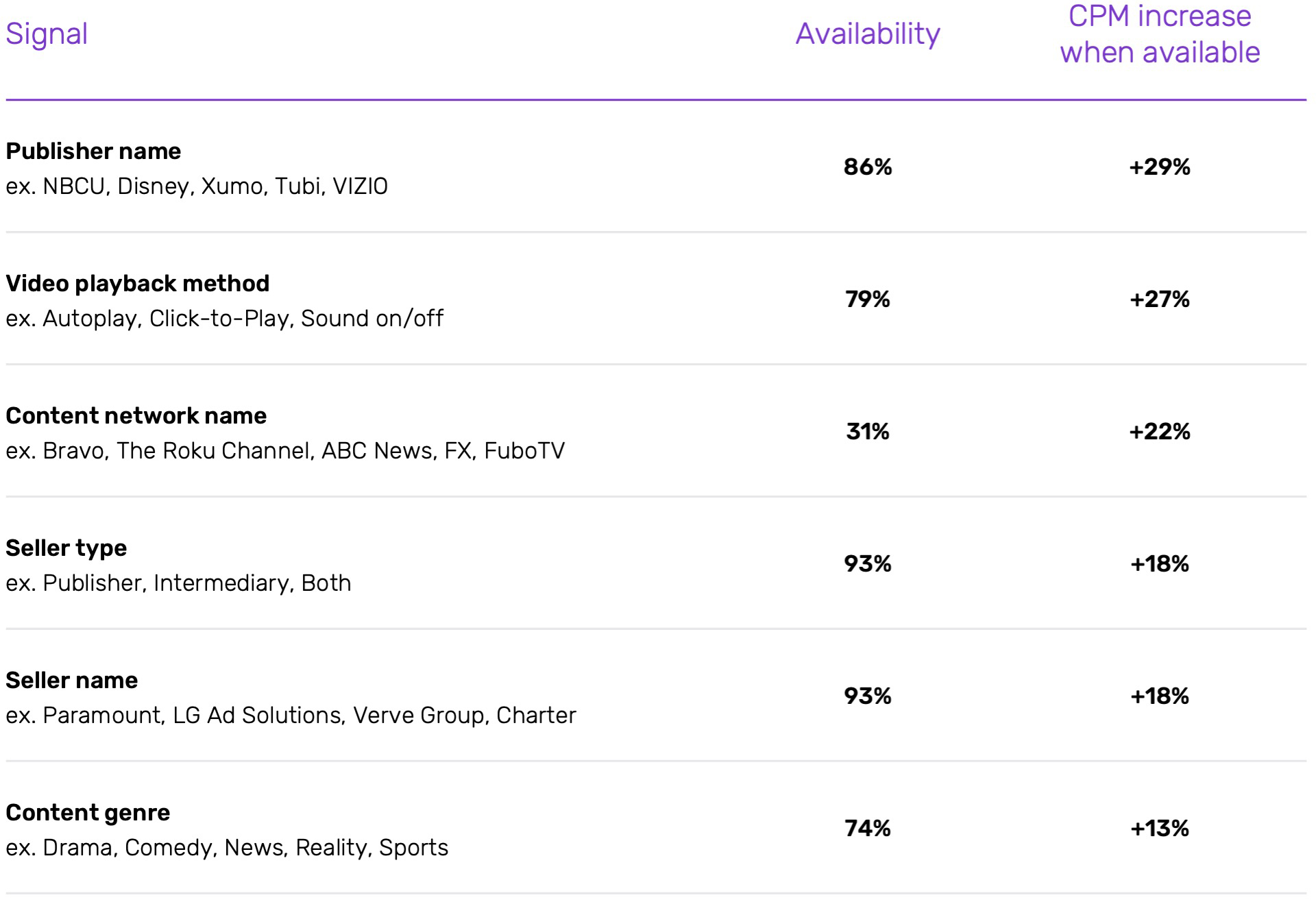
Source: FreeWheel internal bidstream data, Mar 17 – Mar 24, 2026. US only auctions for video placements. Samples representing 4B auctions and 1.3B winning bids. CPM increase as the difference in mean winning bid CPM when auction signal is available vs. unavailable.
Yet transparency at the content level is not always straightforward. Some of the most requested forms of metadata, such as detailed series-level information, may be constrained by privacy considerations, content rights, contractual restrictions, or technical limitations. As a result, the industry’s transparency strategy cannot rely solely on real-time bidding signals.
Transparency can also extend beyond the auction itself. Post-campaign reporting provides another way to offer deeper content insight. Series-level reporting helps buyers better understand the programming environments supporting campaign delivery and performance, allowing sellers to demonstrate the value of premium content without requiring every detail to be exposed during a live transaction.
Identity requires more than foundational signals
Identity is another example of why more signals alone do not solve the industry’s transparency challenges.
In CTV, foundational device and identity signals such as IP addresses and device identifiers have largely become table stakes. Buyers expect them, sellers typically provide them, and the industry increasingly views them as baseline inputs for transacting inventory effectively.
While foundational identifiers are widely available, consistent and interoperable identity signals are not always present or consistently supported across publishers, distributors, devices, and platforms. This is where the market is evolving. Rather than simply increasing the number of identifiers passed in the bidstream, the industry is focused on creating more consistent audience signals, like universal IDs, that can be recognized and activated across premium TV inventory. Recent innovations such as bid signal enrichment are designed to help bridge identity gaps by attaching trusted identity signals to eligible inventory, making more supply addressable for targeting, frequency management, and measurement
Moving toward effective transparency
A new CIMM report proposes a practical path forward: a minimum viable set of supply path, identity, and transaction signals that establishes trust while allowing sellers to maintain control over richer audience and content data. That balanced approach gives buyers the information they need to evaluate opportunities while preserving sellers’ ability to differentiate premium inventory and manage sensitive data responsibly.
CIMM also identifies additional signals that can create incremental value for both buyers and sellers. Download the report here.
That baseline will continue to evolve as technology, privacy expectations, and buyer requirements change, but the principle should remain the same: prioritize signals that are trusted, usable, and relevant to the transaction.
Programmatic transparency should not be measured by how many fields are populated. It should be measured by whether the information reduces uncertainty, improves trust, supports efficient transactions, and helps quality inventory receive appropriate consideration.